
.jpg?alt=media&token=e86decb0-b458-4532-8b4b-0e9f232f3a89)
Forever Free? A Myth. UPI Is Now Chargeable — Here's What Consumers Can Actually Expect

Forever Free? A Myth. UPI Is Now Chargeable — Here's What Consumers Can Actually Expect
From the desk of the Editor, Storyberrys
I still remember the first time I paid for chai with UPI. It felt almost illicit — like I was getting away with something. No cash, no card swipe fee silently baked into the price, no fumbling for change. Just a phone, a PIN, and a little green tick. For years, that feeling never really wore off. UPI wasn't just a payment method in India — it was a small, quiet promise: this will always be free.
This week, that promise got its first real asterisk.

From October 15, the government is introducing a 0.4% fee on certain UPI payments — not on you and me making everyday transfers, but on merchants, and only on the bigger transactions. After spending the last few days reading through the policy, the reactions, the surveys, and the political noise around it, I wanted to write this not as a news brief, but as what it actually feels like: the end of a small, strange era of digital life that a lot of us never questioned because it never asked anything of us.
The Part That Doesn't Change (Which Is Most of It)

Let me be the reassuring editor for a moment, because most of the coverage buries this under jargon. If you're paying for your morning chai, splitting a dinner bill with a friend, or handing ₹150 to an auto driver — nothing changes. Not a rupee, not a rule, not a fine print. Person-to-person transfers stay free forever, no matter the amount. Anything under ₹2,000 paid to a merchant — which is most of what most of us do most days — stays free too. Small shopkeepers earning under ₹1 lakh a month through UPI are protected entirely.
The Part That Made Me Pause
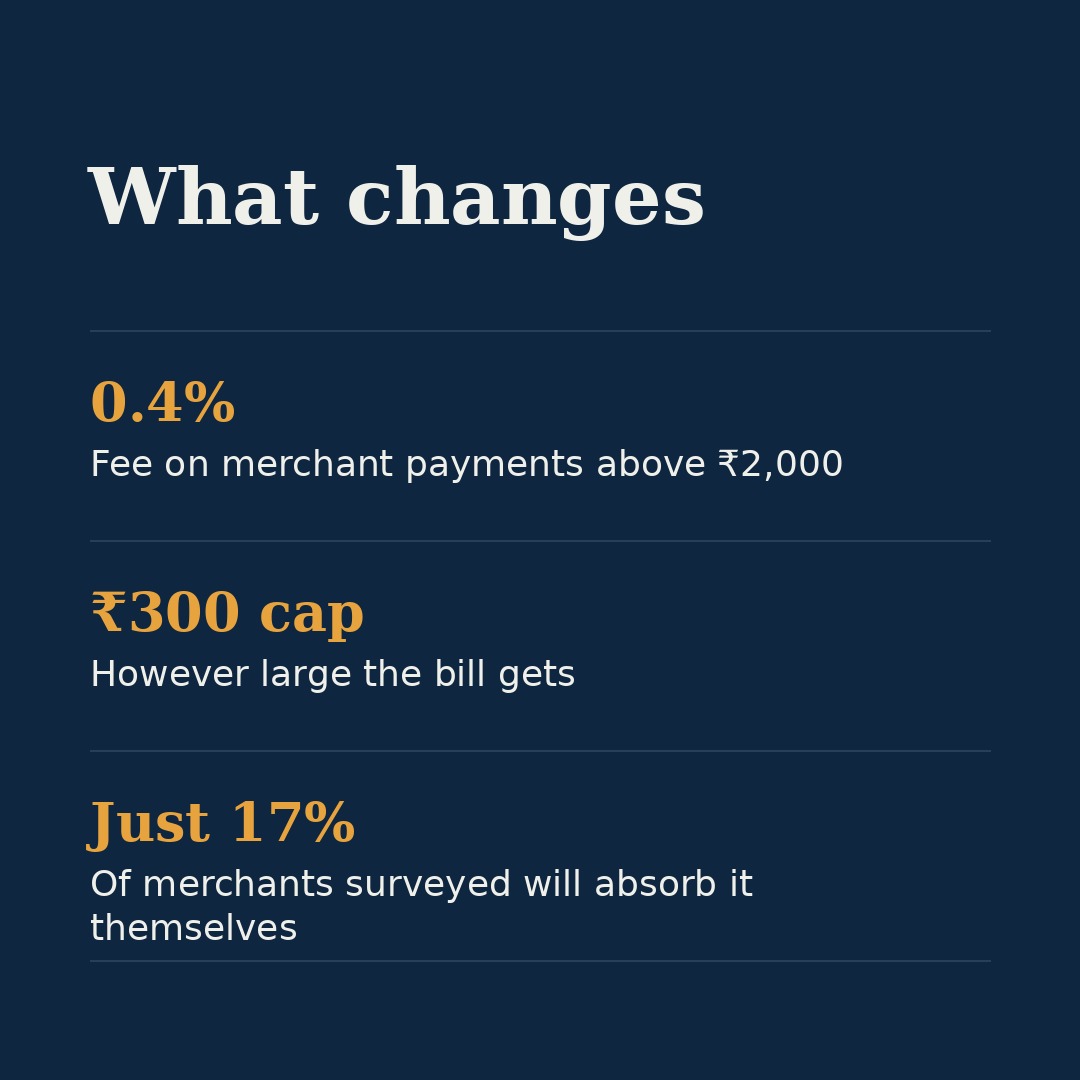
But I kept coming back to one number: only 17% of merchants surveyed said they'd actually absorb this fee themselves. The other 83% are, understandably, going to look for a way around it — and I don't think that's a story about villainous shopkeepers. I think it's a very human story about a decade of built-up habit meeting a sudden new cost. For six years, "UPI is free" wasn't just a technical fact, it was baked into how every merchant in the country priced things, thought about margins, and talked to customers. Asking that to change quietly and cleanly, overnight, is optimistic.
So here's my honest guess at what actually happens next, as someone who's watched enough "free" things eventually ask for something in return: some shops will start offering a cash discount on bigger purchases. Some will nudge you gently toward a card for anything over ₹2,000. A few enterprising folks will split a ₹4,000 bill into two ₹2,000 ones just to dodge the fee entirely — until someone notices and closes that loophole too. None of it will feel dramatic. It'll feel like the slow, almost invisible way prices always move — not the government charging you, not really the merchant either, just the ordinary friction of a system readjusting itself.
Proposal: What If We Went All the Way?
A reader wrote in with an idea that's blunter and more radical than anything the government has actually proposed, and I think it's worth sitting with rather than dismissing: if transactions are going to be taxed anyway, why stop at UPI? Extend a small charge to all bank transactions — every transfer, every payment, every rupee moving through the formal system — and use that as the country's primary revenue engine, replacing income tax altogether.
It's not a new idea, even if it feels like one. A version of it has floated around Indian economic policy circles for years under names like the "Banking Transaction Tax," pitched on exactly this logic: no more tax filing, no more chasing evaders, no more distinction between the honest and the clever — just a tiny, near-invisible clip on money as it moves, applied to everyone, automatically, all the time. There's a genuine appeal in that simplicity, especially for a country where filing complexity and evasion have been persistent headaches.
A flat transaction tax hits every rupee equally, which sounds fair until you notice it isn't — a daily wage payment and a corporate settlement get taxed at the same rate, and poorer households, who transact a larger share of their income rather than saving or investing it, end up carrying more of the burden proportionally than income tax ever asked of them.
There's also the "cascading" problem: money that passes through five hands on its way from raw material to finished product gets taxed five times over, quietly inflating prices at every step in a way income tax, taxed once at the end, doesn't. And replacing a revenue source as large as income tax with something this unpredictable is a genuinely risky bet for a government to make in one move.
I don't think that makes the proposal foolish — it makes it a real trade-off, the kind worth a proper public debate rather than a comment-section dismissal. Maybe that's a note for a future editorial.
For now, though, back to the smaller, less radical truth: UPI isn't broken, and it isn't secretly expensive. It's just no longer entirely free — and maybe, like most things that grow up, that was always going to happen eventually.
I'll still pay for my chai with a green tick tomorrow morning. I just might notice, for the first time in a while, that someone, somewhere in that transaction, is finally being asked to pay for the plumbing.
Rakhi Sunil Kumar
Editor, Storyberrys
Comments (0)
Please login to share your comments.